




What Makes Skyroot’s Vikram-1 Launch a Historic First for India?
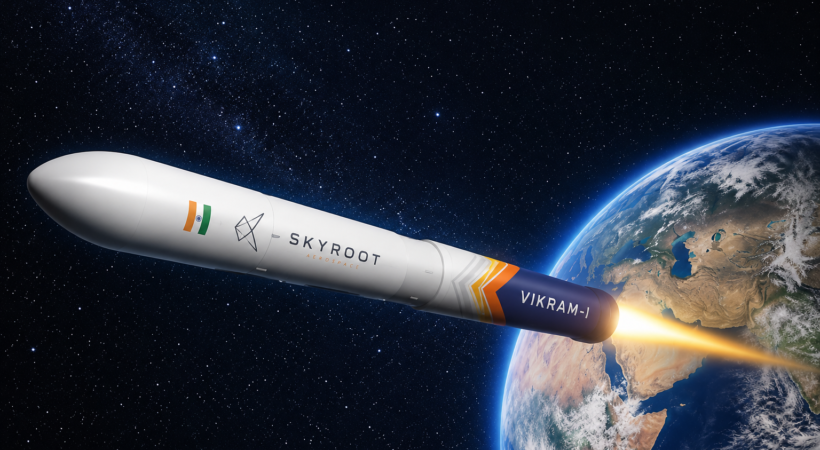
In a historic milestone for India, Skyroot Aerospace launched its Vikram-1 rocket from ISRO’s First Launch Pad at Sriharikota, placing its payloads into an orbit about 450 km above Earth. The mission, named Aagaman—Sanskrit for “arrival”—made India only the third country, after the United States and China, whose private industry has successfully reached orbit using its own launch vehicle.
The four-stage expendable rocket features advanced carbon-composite structures and 3D-printed liquid engines. It is designed to carry small satellites into low Earth orbit.
What makes Skyroot’s Vikram-1 launch unique?
Skyroot Aerospace’s Vikram-1 mission stands out for achieving several firsts for India’s private space industry while introducing new technologies and commercial capabilities.
India’s first private orbital rocket: Mission Aagaman is India’s first privately developed orbital launch vehicle to successfully place payloads into orbit from Indian soil. The achievement marks a major step for the country’s growing private space sector.
Advanced technologies:Vikram-1 brings several new technologies to India’s launch ecosystem.
All-carbon composite structure: The rocket is India’s first orbital launch vehicle built with an all-carbon composite airframe. The lightweight structure improves strength while reducing the rocket’s overall weight. Its first stage is also the country’s longest monolithic carbon-composite rocket stage.
3D-printed liquid engine: The rocket’s Orbital Adjustment Module (OAM) is powered by the Raman-I engine, which uses India’s first fully 3D-printed bi-propellant liquid engine injector on an orbital vehicle. According to Skyroot, this reduced the engine’s weight by about 50% and cut production time by nearly 80%.
Pneumatic stage separation: Vikram-1 uses a pneumatic system to separate its rocket stages and payload fairings instead of conventional pyrotechnics. The system is designed to reduce mechanical shocks that could affect sensitive satellite equipment.
Unique payloads:The mission also carried several distinctive payloads.
Space debris removal demonstration: It carried the EMBRACE mission, featuring a robotic arm designed to demonstrate space debris capture technology.
Scientific and cultural tributes: The rocket also carried Cosmic Bloom, a space-bound lab-grown diamond, along with a miniature 18-karat gold rocket containing micro-sculptures of Dr. Vikram Sarabhai, Sir C.V. Raman and Dr. A.P.J. Abdul Kalam.
Prime Minister’s message: The mission also carried a card featuring Prime Minister Narendra Modi’s “Vande Mataram” message, along with greetings from supporters around the world.
Commercial approach
The Commercial Model: The “Cab” vs. “Train” Concept
Commercially, Vikram-1 is positioned as a dedicated “cab” service for small satellites. Heavy-lift rockets, such as SpaceX’s Falcon 9, operate more like “trains,” carrying hundreds of satellites together as secondary payloads on fixed schedules and predetermined orbital paths. In contrast, Vikram-1 offers on-demand, highly customizable flights. This allows customers to choose their preferred orbital destinations without waiting for a primary payload. The rocket’s modular architecture also enables it to be assembled, integrated, and made ready for launch within just 24 to 72 hours.
Financially, Skyroot aims to disrupt the market by cutting launch costs by 50% compared with established small-lift competitors such as Rocket Lab and Virgin Orbit. In the long term, the company aims to develop rockets at one-fifth of current industry costs.
Boosting India’s Position in the Global Space Economy
India’s space economy was valued at approximately $8.4 billion in 2022, accounting for only a small share of the global market. However, the Indian government aims to increase this share to 10%—around $40 billion to $45 billion—by 2030, and to as much as $100 billion by 2040. Vikram-1 plays a key role in this vision by demonstrating that India’s private sector can successfully manage end-to-end commercial orbital launches.
By relying on the private sector, India can build on its long-standing strength in cost-effective aerospace engineering, a deep talent pool, competitive manufacturing costs, and a favourable launch location near the equator. At the same time, allowing private companies such as Skyroot to handle commercial small-satellite launches enables ISRO to focus on deep-space exploration, human spaceflight, and advanced scientific research.