



When a Screenwriter No Longer Needs a Film Crew: How an Indian Startup Is Building an AI Filmmaking Platform
For years, the gap between finishing a screenplay and seeing it on screen has been a major challenge for many writers. Finding producers, securing funding and assembling a production team can take months or even years. Even before filming begins, translating a written script into shots, camera movements, character positions and visual sequences requires considerable planning and resources. An Indian startup is exploring whether artificial intelligence can make more of this process accessible to writers and independent creators.
AiraScripts, founded by Amal Akshay, a YouTuber, AI filmmaker and screenwriter from Kerala, is being developed with a broader ambition: to build an AI filmmaking platform that helps creators move from a written screenplay towards a visual film. Rather than focusing solely on screenplay writing or storyboarding, the project explores how AI could connect different stages of filmmaking within a single environment.
The idea grew out of Amal’s own experience as a screenwriter. He realised that writing a screenplay was only the first step. Turning the words on a page into something that could be seen on screen involved another layer of work, including visualising scenes, planning shots and coordinating the creative and technical decisions required for production. For writers without access to a production team or the necessary budget, these steps could become significant obstacles.
AiraScripts is an attempt to address some of these challenges by bringing screenplay development and AI-assisted filmmaking tools together. The longer-term vision is to give writers more control over how their stories are visualised and developed, without requiring them to depend entirely on traditional production resources at the earliest stages.
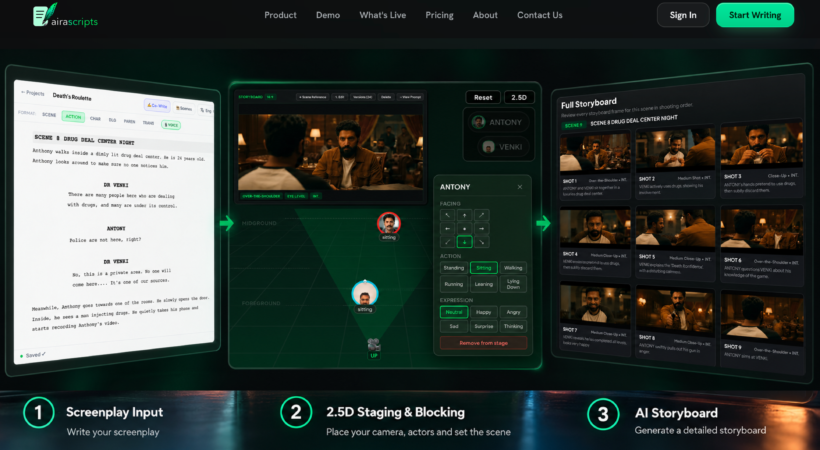
The process begins with the screenplay. Writers can create a script within the platform or upload an existing one. The AI analyses the story, identifies its characters and allows users to add reference images to guide their appearance. These references help maintain visual consistency across scenes, an important consideration when generating multiple images or sequences from the same screenplay.
From there, AiraScripts can suggest shot divisions for individual scenes. Writers can review, edit or rearrange these suggestions before planning camera placement, character positions and eyelines. These details help establish how a scene might unfold visually. The platform can then generate storyboard images for individual shots, allowing writers to explore how their screenplays could look on screen before committing to a physical production.
But storyboarding is only one part of the broader idea. AiraScripts is also exploring the next stage of the process: turning planned shots and storyboard concepts into moving visual sequences. The aim is to develop a workflow in which generated visuals remain connected to the original screenplay, helping creators move beyond static images towards scenes that can be experienced as moving pictures.
The complete script-to-film workflow is still under development. The live platform, available at https://airascripts.in, currently supports screenplay writing and development through AI storyboard generation. The broader ambition is to expand these capabilities into a more connected AI filmmaking experience, bringing more of the journey from script to screen into one platform.
Alongside these filmmaking tools, AiraScripts includes features intended to make screenplay writing more accessible. Writers can collaborate in real time, work in dark mode, export scripts as PDFs and reorder scenes as their stories evolve. Its voice-to-screenplay feature allows users to narrate scenes and have their words organised into screenplay format. It supports English and several Indian languages, including Hindi, Gujarati, Bengali, Punjabi, Marathi, Malayalam, Tamil, Telugu and Kannada.
The platform also offers three free screenplay projects without watermarks or page restrictions. This gives beginners an opportunity to explore screenplay writing and experiment with the platform before committing to a paid plan. For aspiring filmmakers who want to develop their stories visually but have limited resources, access to these early-stage tools could provide a practical starting point.
AiraScripts is being developed at a time when generative AI is beginning to change how independent creators approach filmmaking. AI tools can already help with concept art, character design, storyboards and the generation of visual sequences. Connecting these capabilities into a workflow built around a screenplay presents another possibility: allowing writers to develop not just the story, but also an early visual interpretation of how it might appear as a film.
For India’s filmmaking landscape, this possibility has particular relevance. Stories are written in numerous languages, and aspiring creators come from backgrounds with widely varying access to funding, equipment and industry connections. A platform that lowers some of the technical and financial barriers to visual storytelling could give more writers an opportunity to explore their ideas and communicate them to potential collaborators.
However, building an AI filmmaking platform involves challenges beyond generating convincing images. Maintaining character consistency, controlling movement, preserving continuity between shots and ensuring that generated scenes follow the screenplay are difficult technical problems. A collection of AI-generated clips is not automatically a coherent film, and a finished production still requires creative judgement, editing, sound, performance and a clear understanding of storytelling.
AiraScripts does not yet offer a complete replacement for a traditional film production workflow. Its current capabilities focus on screenplay development and storyboarding, while the broader script-to-film process remains a work in progress. The distinction is important: the ambition is larger than the product’s present capabilities, and reaching that ambition will depend on how successfully its different stages can be connected.
The larger idea, however, goes beyond previsualisation alone. By developing tools that connect screenplay writing, shot planning, storyboarding and future AI-generated video workflows, AiraScripts is exploring what a more accessible filmmaking process might look like. Instead of treating the screenplay as a document that must be handed over to another team before visual development can begin, the platform aims to help writers participate in more of that process themselves.
Whether AI can eventually enable an individual creator to produce an entire film within a single platform remains an open question. For now, AiraScripts is working towards that possibility, starting with the stages it can support today and developing towards a broader script-to-film workflow.
Its ambition reflects a growing question for the film industry: as AI filmmaking technology advances, could the distance between having a story and bringing it to the screen become smaller? For AiraScripts, the goal is to explore that possibility by putting more of the filmmaking process within reach of the people who write the stories.